Category Archives: Uncategorized

XML for the Long Haul

There will be a one-day symposium on the theme XML for the Long Haul, right before the Balisage conference in Montréal this year. I’ve thought about this, lately.

First of all, isn’t this what XML is about? The ability for information to survive a proprietary method of conserving it? The means to make it happen, regardless of what happens to your software? I’ve preached about this for a long time for my customers, listeners, and those who just couldn’t get away. If a disaster happened to your software, if it was somehow wiped out in spite of your best efforts, my point was that it would only take a few days to build something that would parse most of the information in an XML file. Maybe another few days to produce output from it, but provided that you spoke the written language and the structure was done by someone who had at least a basic idea of what XML (and SGML; this isn’t new) was about, it wouldn’t take more than a few days at most to see what that lost information was about.

Second, my points re the first, above, pretty much summarise my views here, but I really mean it: This is what XML is about.

But is it really that simple? Is markup really that descriptive? Well, not always. There’s plenty of markup out there that is obscure and hard to read. For example, is a namespace going to make your leftover instances easier to read? Are your element type names descriptive? What about your attributes? Do you include comments or annotations with your schema? Do you include wrappers that contain groups of element types in a semantically meaningful way? Does your group include everything required for that group to be complete? Have a look at one of your instances with fresh eyes, see if it makes sense. Does one type of information relate to another? How would you format this lost instance, if you had just come across it? If it had been a thousand years and you could understand the language but not the culture, would you understand the meaning of the information? Could you print it and explain what went on then?

Don’t laugh. Pretend that you really are viewing your structures from the outside. Pretend that you don’t have the schema at hand. Pretend that you don’t know the semantics, even though you can understand the contents. Pretend that you really are studying the information as an outsider. Does it all make sense?

I think this is a worthwhile reality check. I think that we all should ask this of the schemas we create, every time we do an information analysis. Are our schemas understandable? Are they legible?

I would really like to be in Montréal in August this year. I think it’s important.
Amarok Woes

Amarok, the best music player there is for Linux or indeed any platform, has been redesigned from the ground up. The old version 1.4, while feature-rich, was apparently up to the standards and visions of the app’s makers, and now, there is a 2.2 out.

Amarok 2.2 is completely different in terms of appearance (and probably even more internally), but right now I’m having lots of trouble getting it to work the way 1.4 did. Here’s what’s bugging me the most:

  • I can’t seem to get the playlists to sort my music according to albums without every album on the list being listed once for every song that album contains. VERY frustrating.
  • Version 2.2 reintroduced the capability to play audio CDs. However, this feature doesn’t seem to work on my laptop–the CD is listed but just won’t play (even Kscd plays on the laptop and that’s to say a lot). On my desktop, the CDs will play, though.
  • CD title lengths are always 0:00. Annoying.

I’m sure these will be sorted out in time, but right now, when KDE 4 is still buggy and unreliable, and Pulseaudio still mutes sound on every boot, there is enough on my plate already to keep me annoyed.

I Hate Windows

This blog is about blame. Specifically, it’s about Windows XP. If you’re into the Microsoft-friendly thing, quit reading.

I held my presentation at XML Prague today. It seemed to go reasonably well until I was about to switch to a demo. I was in Powerpoint and meant to show a little something on the actual application, so I switched to Internet Explorer, or so I thought.

NOTHING happened. Nothing. Zip. Zilch. Zero. Nothing whatsoever.

Nothing. Can you imagine the terror? WTF?

I kept on speaking, realising that my presentation wasn’t up to par. Another demo opportunity came up, with similar results.

Nothing.

And that is what happened. Nothing. You explain this, because I can’t.

XML Is Progress…

…but I miss SGML. I miss the time when any project worth its salt was up to a year or more but would still have to be redone from scratch to create something that actually works.

These days, companies expect these things to work right out of the box. Just install it, give it a week’s training and another week of adjustments, and you’re all set. I have competitors that market their product in this way, claiming that it’s all it takes. Funny, that, because what they are actually saying is that the handling of a customer’s most vital asset, their information, should require no more than a couple of weeks to be up and running but the product itself could take years to develop. Is it just me or is there something wrong with this concept?

In the olden times, things were never that easy. There was no DOM and there was no XSLT, and certainly no native, built-in SGML APIs to ease a developer’s plight. No fast track, no overnight results. Outputting structured documents on paper was not an easy task so things were allowed to take time. There was time to do a proper analysis, and time to perfect it while others were writing code.

Imagine having that time now, imagine having a year to do things properly. Oh, yes, I miss SGML.

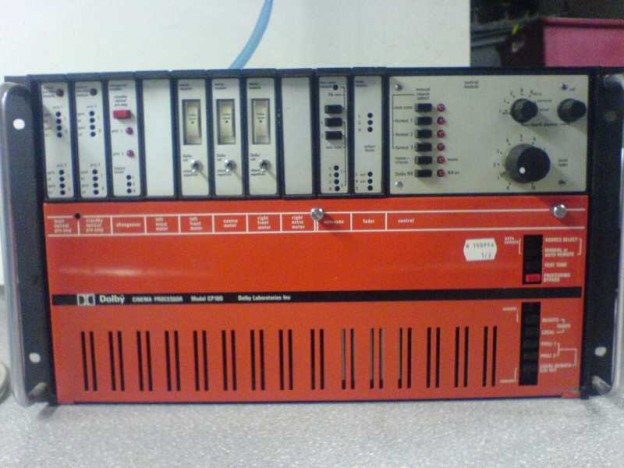
Dolby CP100


I got hold of a Dolby CP100 cinema sound processor. It’s Dolby’s oldest Dolby cinema processor, introduced nearly 33 years ago. I don’t expect to actually use it a lot, but I’m very tempted to install it in the sound rack at the cinema, just to freak out visiting filmmakers.

In any case, I think it’s the most beautiful-looking processor Dolby has ever made. ::sigh::